The Question Nobody Answered: How Pre-Purchase Friction Quietly Kills Sales
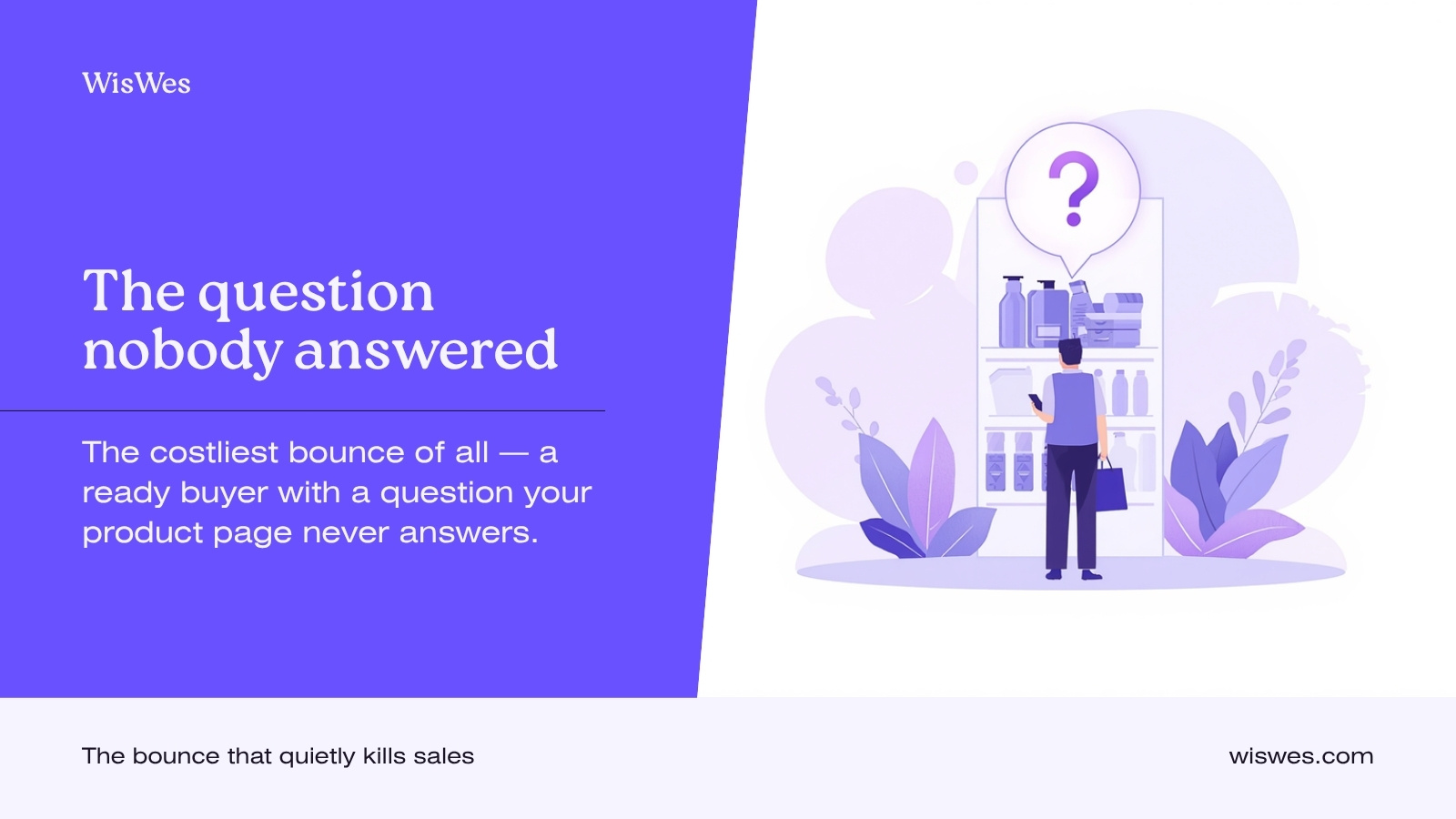
A shopper lands on one of your product pages and likes what they see. The photos are good, the price is fair, the reviews check out. They are, in every way that matters, ready. And then a small question forms — the kind that always forms right before someone spends money:
Does this fit a 14-inch laptop? Is the cotton pre-shrunk? Will it arrive before Friday? Is the blue the same blue as the photo?
They look for the answer. It is not in the description. The FAQ tab is a wall of generic policy text that does not mention their case. The chat bubble in the corner routes to a human who is asleep, or to a bot that answers a different question. Thirty seconds pass. The question is still unanswered — so the shopper does the only rational thing left. They leave to find a store that will answer. And, having found one, they buy there.
This is the first and most expensive entry in the seven reasons shoppers bounce, and it deserves its own essay because almost nobody measures it, almost everybody causes it, and the fix is not the one most stores reach for.
Why this is the most expensive bounce of all
Not all bounces are equal. A visitor who leaves the homepage in two seconds was barely a prospect. But the shopper who bounces from a product page with an unanswered question is the most valuable person on your entire site — and you lose them at the worst possible moment. Two things make this bounce uniquely costly.
It happens at peak intent. This shopper was not browsing. They had chosen. They were one reassurance away from their wallet. Every other reason in the funnel bleeds shoppers who were still deciding; this one bleeds shoppers who had already decided yes and only needed a detail confirmed. You are not losing a maybe. You are losing a sale that was effectively made.
It is invisible in your analytics. This is the cruel part. The shopper read the page, scrolled the specs, lingered while they hunted for the answer — so in your dashboard it looks like engagement: a long, healthy dwell time, then an exit. It reads like interest. It was actually a question dying in silence. There is no "left because of an unanswered question" row in Google Analytics, so the most expensive thing happening on your store is the one thing your reports actively disguise as a good sign.
The questions that actually go unanswered
"Add more detail to your product pages" is not advice anyone can act on, because the problem is never the amount of detail — it is that the one detail this shopper needs is the one detail that is missing. And the missing detail is almost always one of a small, predictable set. These are the questions that strand ready buyers:
| Question type | What the shopper is really asking | Where it strands them |
|---|---|---|
| Fit & sizing | “Will this fit me / my space / my device?” | Apparel, furniture, accessories, cases |
| Compatibility | “Will this work with the thing I already own?” | Electronics, parts, refills, software |
| Material & quality | “Is it the real thing — and will it last?” | Fashion, homeware, tools |
| Delivery timing | “Will it arrive in time for the date I need it?” | Gifts, events, seasonal |
| Stock & variants | “Is my size / colour actually available?” | Any catalogue with options |
| Use-case fit | “Is this the right one for what I actually do?” | Anything with multiple similar SKUs |
| Returns & risk | “What happens if I’m wrong?” | First-time buyers, higher price points |
Notice that none of these are answered by a better hero image or a punchier headline. They are answered by a conversation — a shopper saying what they need, and the store responding with something specific and true.
Why your FAQ page doesn't fix this
The instinct, once you accept the problem, is to write more FAQs. It feels like the answer. It is not, for three reasons that are worth naming because they explain why stores keep pouring effort into a page that does not move the number.
- Nobody reads a wall to find one line. A shopper with a single, specific question will not scan forty unrelated Q&As hoping theirs is in there. The cost of searching exceeds the cost of leaving.
- The question is contextual. "Does thisfit a 14-inch laptop" is about the product on the screen right now. A site-wide FAQ cannot answer a product-specific question; it can only answer the generic version, which is not the one being asked.
- It is phrased in their words, not yours. The shopper asks for a "waterproof jacket"; your FAQ talks about "hardshell membranes." They ask if it is "good for flat feet"; your page lists "stability category." A static page cannot translate between the shopper's language and your catalogue.
A FAQ page answers the questions you anticipated, in the words you chose, on a page the shopper has to go find. The unanswered question is, by definition, the one you did not anticipate — asked in the shopper's words, on the page they are already on.
How to find out if this is happening to you
Because it hides as healthy engagement, you have to go looking. Four places where the evidence is sitting in plain sight:
| Where to look | What to look for |
|---|---|
| Product-page exits | High dwell time, high scroll depth, then exit with no add-to-cart |
| On-site search logs | Searches phrased as questions (“does … fit”, “is … compatible”) |
| Pre-sale support tickets | Questions asked before purchase — each one is ten that left silently |
| Session recordings | Shoppers scrolling up and down the same page, hunting, then leaving |
The pre-sale support tickets are the tell. For every shopper motivated enough to open a ticket and wait for a reply, many more had the same question and simply left. Your support inbox is a sample of the questions your product pages are failing to answer — read it as a to-do list, not a chore.
The fix: let them ask, and answer in the moment
The shape of the fix follows directly from the shape of the problem. If the questions are specific, contextual, and phrased in the shopper's own words, then the answer has to be specific, contextual, and given in the shopper's own words — at the moment of doubt, on the page they are already on. That is not a longer FAQ. That is a conversation.
Concretely, the store needs to be able to do what a good in-person sales assistant does without thinking: hear "will this fit a 14-inch laptop?", check the actual dimensions of the actual product, and answer "yes — it fits up to 15.6 inches" before the shopper has finished reaching for the back button. This is exactly the job conversational commerce was built for: the shopper asks, the store answers from real product data, and the sale survives the question instead of dying on it.
Two things have to be true for that to work, and the second is the one stores forget. First, the shopper needs a way to ask in plain language — not a decision tree, not a search box, an actual question. Second, the answer has to be grounded in your real catalogue and policies, or it is worse than silence: a confident wrong answer about fit or stock or delivery loses the sale and the trust. Which is why an assistant is only as good as the product data behind it — the groundwork we cover in getting your product catalogue AI-ready. Answer the question from the truth, and the most expensive bounce on your store simply stops happening.
The one-line version
The costliest thing a shopper can do is leave with a question you could have answered. It happens at the peak of their intent, it disguises itself as engagement, and no amount of extra copy fixes it — because the shopper does not need more words on the page, they need an answer to theirword, right now. Give them a way to ask and a true answer in the moment, and a sale you were quietly losing becomes a sale you quietly keep.
This is reason one of seven. Next in the series: the shopper who isn't missing an answer at all — they are drowning in options, and no one is there to narrow the forty down to three.